
Shield M
€10,99 EUR / mo
A development server, or a small gamemode with few scripts.
- 2× vCPU · Ryzen 9 9950X
- 2 GB DDR5 RAM
- 40 GB NVMe SSD
- Port 25 Gbps shared 8 TB fair use (outbound)
- Advanced DDoS protection
- 1× IPv4 address
- IPv6 /64 included
A RageMP server is a live session with an audience watching it, which is most of the reason roleplay communities see more of this than a static site of the same size ever would. The attack produces something the attacker can watch happen. Players time out, the server empties, and the community Discord does the rest.
The transport makes it easier to try. RAGE:MP carries its session traffic over UDP, and UDP gives a network device no handshake at the transport layer to lean on when it decides whether a packet came from a real client. Something has to understand the framework specifically to make that call.
Being exact about this is more useful than quoting a capacity number.
Every packet aimed at our range crosses the scrubbing layer before it reaches a customer machine, and on Shield that happens continuously rather than after a trigger. For RAGE:MP the profile is flagged experimental, which is how we mark one that is still being tuned. It applies the baseline anti-spoofing and connection-flood filtering, so the traffic patterns behind most of what people report get dropped at the edge.
What it does not do yet is validate the RAGE:MP handshake the way the Cfx.re profile validates FiveM’s. A crafted packet that looks structurally plausible is judged on rate and shape rather than on whether a real RAGE:MP client could have produced it. If that distinction matters for what is hitting you, the next section is the one to read.
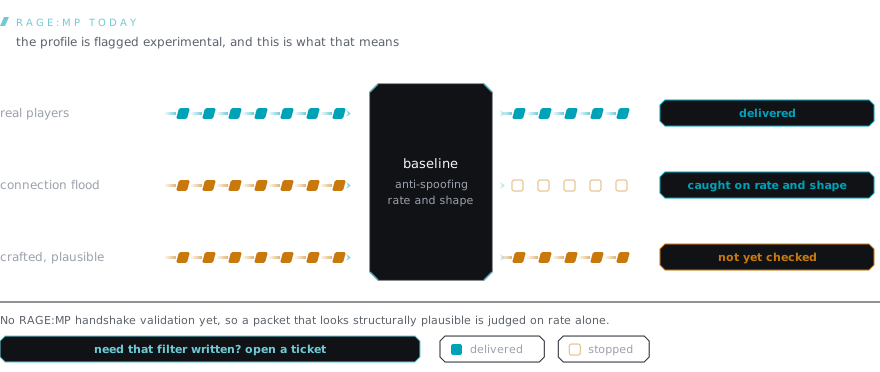
None of that changes the always-on part. Shield keeps every packet crossing the filter continuously, so the roughly five second detection window that exists on the reactive line does not exist here. That window is the thing that disconnects a full server at once.
Ask for one. We write custom XDP filters for customers as part of support rather than as billed consulting, and RAGE:MP is a case where asking is worth it if you are being hit more than once.
Open a ticket with the attack signature, the affected port, or just the IP being hit: submit a support ticket. Bring a packet capture if you can get one, because a filter written against traffic we can look at beats a filter written against a description of it.
For a server with players connected, Shield. The always-on filtering is the part that helps a RageMP server today, and it helps regardless of how mature the per-title profile is, because the detection window it removes has nothing to do with which game you run.
If budget is the constraint, the standard VPS line includes reactive mitigation at no surcharge and costs less. That is a real option for a development box or a server you are still putting together. It is the wrong trade once people are connected, for the reason above.
Our filtering and our machines are both in the Frankfurt metro, so packets for players across Germany, Austria, the Netherlands and Poland are not detoured to another country to be cleaned and sent back. If your community is mostly North American, a European host is the wrong answer however good the filtering is.
RAGE:MP asks for less than FiveM at the same player count, mostly because the asset stacks tend to be smaller, but the shape of the problem is the same. Your scripts run on one thread, so clock speed sets the ceiling and spare cores go to the database rather than to the tick.
The runtime is the part that is easy to forget. A gamemode written against Node or .NET keeps that runtime resident next to the game process, and a garbage collector under load is exactly the sort of pause that reads as lag to a player. Leaving headroom above what the server appears to need is worth more here than the last gigabyte of the tier below.
shield plans
Pricing in EUR · 20% Austrian VAT for AT consumers · Reverse charge for EU B2B
We could find no published hardware requirement for RAGE:MP, and its wiki blocks automated access, so treat the two tiers below as our recommendation and nothing more. The runtime your gamemode is written against, Node or .NET, sits in memory alongside the game process and is what sets the floor.
A development server, or a small gamemode with few scripts.
A populated roleplay server with a database alongside.
A large community on a heavy script and asset stack.
Every tier carries the same always-on filtering and the same 25 Gbps uplink, so the choice above is about compute, not about protection.
Both, and the honest answer is that the RAGE:MP profile is newer than most of the list. It is flagged experimental, which is what we mark a profile as while it is still being tuned. Today it applies baseline anti-spoofing and connection-flood filtering to your session traffic. It does not yet validate the RAGE:MP handshake the way our Cfx.re profile validates FiveM's. If you want that for your server, ask and we will write it.
For a roleplay server with players connected, Shield. Filtering on the Standard line is reactive, and the roughly five second window before it engages is long enough to disconnect everyone on the box at once. An attacker only has to repeat that. A Standard VPS is the cheaper machine and the right one for a development server or something you are still building, and the wrong one for a server people are on right now.
No. We write custom filters as part of support rather than billing it as consulting, and your change does not sit in a vendor queue behind someone else's ticket. Bring a packet capture if you have one. A filter written against traffic we can see is better than one written against a description of it.
The filtering runs as an XDP program at our own edge in the Frankfurt metro rather than in a scrubbing centre in another country, so packets are not detoured before they reach you. The classification itself costs little enough to sit inside normal jitter. Distance is what players actually feel, which is why where the filtering happens matters more than that it happens.
Yes, and that is the common case for a new Shield order. The filtering is always on rather than triggered, so there is nothing to switch on once you are running on a Shield IP. The slow part is moving your server and telling your players the new address.