
Shield S
€6,99 EUR / mo
A gamemode with no database, or one you are still writing.
- 1× vCPU · Ryzen 9 9950X
- 1 GB DDR5 RAM
- 20 GB NVMe SSD
- Port 25 Gbps shared 5 TB fair use (outbound)
- Advanced DDoS protection
- 1× IPv4 address
- IPv6 /64 included
SA:MP has been running since 2006 and the servers that survive are roleplay communities with regulars, a Discord and a hierarchy. That is a target with an audience, and the attack produces something the attacker can watch: players time out, the server empties, and someone posts about it.
The technical side helps them. SA:MP carries its traffic over UDP, and UDP has no transport-layer handshake a network device can use to separate a real client from a crafted packet. Something has to understand SA:MP specifically to make that call. Most generic protection does not, which is why a server can sit behind advertised DDoS protection and still lose its players.
Every packet aimed at our range crosses the scrubbing layer before it reaches a customer machine, and on Shield that happens continuously rather than after a trigger. The SA:MP profile validates the traffic going to your server and drops what does not hold up, so spoofed sessions and connection floods stop at the edge instead of arriving and being dealt with on your box.
It runs as an XDP program at that edge. Dropping a packet there costs a roughly fixed amount of work no matter how large the attack gets, and it costs your server nothing, because the packet never arrives.
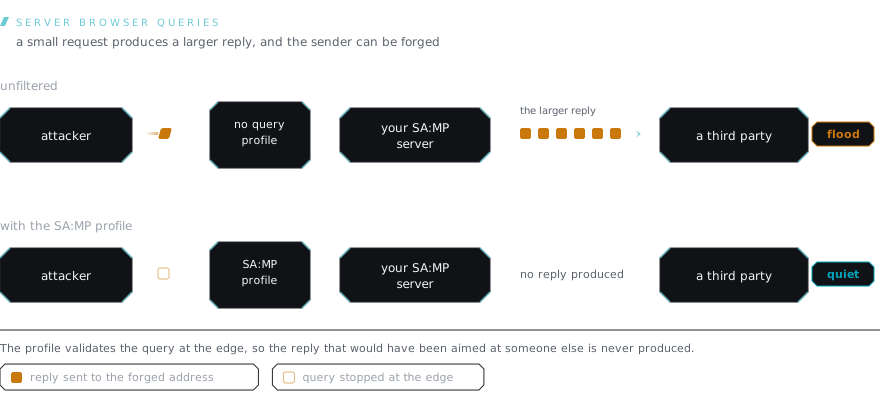
Your server answers the SA:MP browser so it can appear in the list with a name, a player count and a ping. Those queries are small requests that produce larger replies, which is the shape an attacker wants for reflection: send a query with your address forged as the sender, and your server helps flood someone else. The same mechanism run against you fills the service that answers the browser, and a server nobody can query is functionally a server nobody can find.
The profile covers that traffic alongside the gameplay traffic. Worth knowing, because a lot of advice about protecting a SA:MP server stops at the game port and leaves the part that makes you visible unprotected.
Nothing at the network layer helps with an application problem. A gamemode that blocks on a database query, a filterscript that leaks memory, or a server that falls over at 300 players will do exactly that with perfect filtering in front of it. Attack traffic and a bad tick feel identical to a player, and it is worth knowing which one you have before buying anything.
For a live server, Shield, because the always-on filtering removes the detection window that disconnects everyone at once. The standard VPS line includes reactive mitigation at no surcharge and costs less, which makes it a reasonable development box and a poor home for a server people are on.
Our filtering and our machines are both in the Frankfurt metro, so for European and North African communities the packets are not detoured to another country to be cleaned and sent back. SA:MP populations are concentrated in places that are a long way from Frankfurt, so check where your players actually are before deciding. Latency you add by hosting on the wrong continent is not something mitigation can give back.
A SA:MP server on its own is light enough that the game is rarely what you are buying for. The gamemode runs on a single thread, so clock speed decides how much Pawn you can execute per tick and additional cores do nothing for it.
What actually sets the tier is everything you put beside it. A roleplay server means MariaDB on the same box, and the database wants both memory and the spare cores the gamemode cannot use. Add logs that grow all month and a compiler toolchain if you build plugins locally, and the entry tier stops being enough long before the game does.
shield plans
Pricing in EUR · 20% Austrian VAT for AT consumers · Reverse charge for EU B2B
Neither SA-MP nor open.mp publishes a hardware requirement; the install guides cover libraries and stop. The server binary itself is genuinely small, which makes SA:MP the one title here where the entry tier is a real answer rather than a compromise.
A gamemode with no database, or one you are still writing.
A roleplay server with MariaDB and logs on the same box.
A long-running server with a large database behind it.
Every tier carries the same always-on filtering and the same 25 Gbps uplink, so the choice above is about compute, not about protection.
Yes, and that matters more on SA:MP than on most titles. The server answers browser queries on the same UDP service that carries gameplay, so a query flood and a gameplay flood arrive at the same place. The profile filters both. There is also a separate Steam query profile on Shield for titles listed through Steam, which SA:MP is not, so for you the SA:MP profile is the one doing the work.
Usually because the filtering is reactive rather than always on. Reactive mitigation has to notice the attack before it engages, and that decision takes a few seconds. For a web server that is a slow page load. For SA:MP it is every player timing out at once, which is the outcome the attacker wanted, and they can simply repeat it. Always-on filtering has no such gap because nothing has to be triggered.
For a server with players connected, Shield. Filtering on the Standard line is reactive, with roughly a five second window before it engages, which is long enough to disconnect everyone on the box. A Standard VPS is cheaper and it is the right machine for a development server or a gamemode you are still writing, and the wrong one for a live roleplay server.
The filtering runs as an XDP program at our own edge in the Frankfurt metro rather than in a scrubbing centre in another country, so packets are not detoured before they reach you. The classification itself costs little enough to sit inside normal jitter. Distance is what players feel, which is why where the filtering happens matters more than that it happens.
Yes, and that is the common case for a new Shield order. The filtering is always on rather than triggered, so there is nothing to switch on once you are running on a Shield IP. The slow part is moving your server and telling your players the new address.