Rust attacks arrive on a schedule
The thing that makes Rust different is when the traffic shows up. Attacks land during raids and at peak population, because that is when a disconnect does the most damage to a server’s reputation. Somebody loses a raid, and the server goes down twenty minutes later.
That timing is the argument for always-on filtering, and it is worth being concrete about why. Reactive mitigation has to notice an attack before it can act. On our Standard VPS line that decision takes roughly five seconds. For a web server, five seconds of packet loss is a slow page load. For a Rust server mid-raid it is every connected player dropping at once, and there is nothing stopping the attacker from repeating it as soon as filtering stands down.
What Rust DDoS protection actually filters
Every packet aimed at our range crosses the scrubbing layer before it reaches a customer machine, and on Shield it does so continuously. For Rust the relevant filter validates the RakNet handshake: a connection that cannot complete one correctly is dropped at the edge, which is where bot joins and connection floods stop.
The filtering runs as an XDP program at our own edge in the Frankfurt metro. Dropping a packet there costs a roughly fixed amount of work no matter how large the attack gets, and it costs your server nothing, because the packet never arrives.
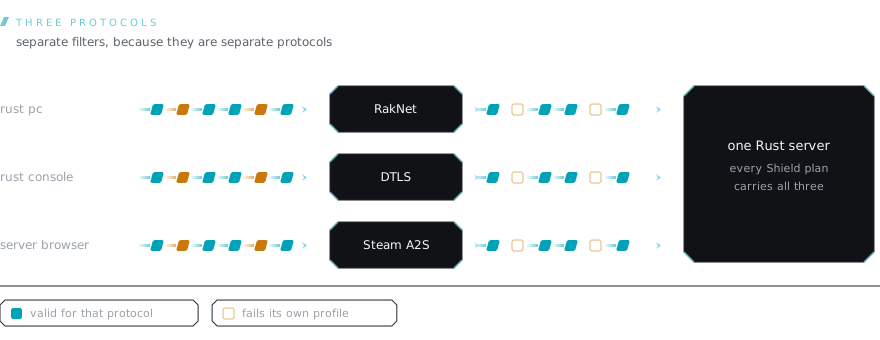
Rust Console is a separate profile, since it uses DTLS rather than plain RakNet. Your server browser listing is Steam query traffic and has its own profile again. All three ship on every Shield plan, and they are separate filters because they are separate protocols.
What it will not fix
A Rust server is heavy. Large maps, high population and a deep plugin stack all cost single-core performance, and entity counts late in a wipe cost more. None of that is a network problem, and no amount of filtering in front of the box changes it.
This matters commercially, so it is worth saying plainly rather than in a footnote: if your server stutters at 150 players on a month-old map, protection is not the product you need. Attack traffic and a saturated main thread feel identical from the client, and it is cheap to establish which one you have before spending anything.
Sizing it
Rust is the most demanding server we host, and the gap between it and the rest is not close. Facepunch asks for 12 GB of RAM before you have added a single plugin, which is more than four of our six Shield tiers have in total.
Two things push it past that number. Map size is one: memory scales with the world, and a 6k map costs noticeably more than the 3k default. Wipe age is the other, and it is the one people are caught by. Entity counts climb all month as bases go up, so the server that sat comfortably on wipe day is a different workload three weeks later. Size for week four, not for the first evening.
The rest is single-core speed. Rust’s tick runs on one thread, so clock rate decides your framerate under load and extra cores go to the plugins and the database beside it.